

NemaČki Svuda
Online German Language Classes


Get to know the German Spirit and Culture through the Works of Famous German Painters!
How better to understand German culture than through its art? Its history and passions are reflected in the work of artists who shaped the spirit of their time. Here are five key figures of German art that will inspire you:
A language is best acquired when you decide to immerse yourself in the tradition that uses that language. Therefore, today there are German painters on the list, and I have singled out 5 of the most influential (not necessarily the best) for you.
1. Albrecht Dürer
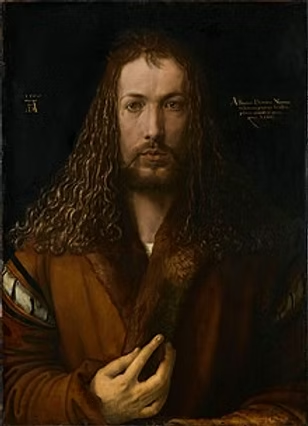
Albrecht Dürer is one of the most significant figures when it comes to the spread of Renaissance culture beyond the borders of Italy. He was born in 1471 in Nuremberg and gained a reputation as one of the greatest masters of art in the age of humanism and the Reformation. He is known for his fine woodcuts and copperplates, but his oeuvre also includes numerous portraits, altarpieces, watercolors, and books on human properties. He found inspiration in nature, mythology, as well as in allergic and religious themes. You must have seen his Self-Portrait, and art lovers surely remember his most famous etchings The Knight, Death and the Devil, as well as St. Jerome in a Cell.
2. Caspar David Friedrich

When we talk about German romanticism, we can't help but mention Caspar David Friedrich. He was considered the most important artist of his generation (from today's point of view) and was at the forefront of the German romantic movement. He especially stands out for painting landscapes, where figures of a human form and often of a dwarf nature can be seen. His work is imbued with allegorical meaning, often emphasizing human helplessness before the indestructible forces of nature. One can feel the longing and the desire for a person to leave the infinity of nature and thus be tied to it again. Among the most significant works, I would single out Wanderer above the Sea of Fog, Monk by the Sea, Moonlight above the Sea.
3. Paul Klee

Have you heard of the Bauhaus as well as the artistic group of expressionist painters Blue Rider? Well, Paul Klee is one of the key figures of this new, influential movement where, together with his friends Wassily Kandinsky, Franz Marc and August Macke, he created the basis for the development of German Expressionism. He taught at the Bauhaus school between 1921 and 1931, after which he also taught briefly at the Düsseldorf Academy. However, threats from the Nazi party, which declared his art degenerate, forced him to flee to Switzerland, where he died in 1940. The castle and the sun, Ad Parnassum, Die Zwitscher-Maschine are one of his most famous works.
4. Max Ernst

Max Ernst was a pioneer of European surrealism and the Dada art movement. His collages from 1919-1920 depict a phase of Dada art. Ernst spent four years serving at the front during the First World War, which had a special impact on his work. Following the momentum of the surrealist movement, he went to Paris, and then, because of the Second World War, to America, where he encouraged the development of abstract expressionist art. Favorite works from his oeuvre are The Elephant Celebes, The Forest and the Dove, as well as Napoleon in the Wild.
5. Gerhard Richter

And finally, the artist of today, Gerhard Richter, whose works have sold for millions of dollars at auctions. He was born in 1932 and is one of the most famous living German artists. He is known for his abstract paintings and photo-realistic works. Like Picasso, Richter does not stick to one style, and although he was associated with several artistic movements, his work cannot be placed under one specific genre. The works that I would single out are Abstraktes Bild (599) and Abstraktes Bild (809-1).
Want to learn more about culture and language? Visit my website German everywhere and discover how to immerse yourself in the rich traditions of this country while learning the German language.